
This post could possibly be the most valuable you’ve read in awhile. The information contained here is not generally known, much less publicized. If you have any money in a bank, it is imperative that you know the status of your money and/or bank.
The key element of this post revolves around ‘derivatives’. What are derivatives?
Simple definition: a financial instrument whose value is based on another security; a financial ‘investment’ based on loans of homes, vehicles, or other property
Detailed definition: A financial contract whose value is derived from the performance of underlying market factors, such as interest rates, currency exchange rates, commodity, credit, and equity prices. Derivative transactions include a wide assortment of financial contracts including structured debt obligations and deposits, swaps, futures, options, caps, floors, collars, forwards and various combinations thereof.
In recent years people have been able to get home loans with little or no credit (rating). In some cases those loans were based on a very small down payment on the property in question. Consequently the inhabitants were able to procure property with little exposure to themselves (other than possible bad credit). The banks on the other hand saw these derivatives as opportunities to make obscene amounts of money. This behavior is what led to the real estate ‘bubble’ in the 2008 timeframe which in turn led to the stockmarket crash and economy implosion. The solution then was to ‘bail out’ the banks. Back then the country was in hock for very little money compared to today — almost $20 trillion.
Today those derivatives have grown immensely! (We haven’t learned much since then..?) Consequently the banks are on the hook for ‘trillions of dollars‘ in derivatives. How much you ask? Let me put the answer in perspective. If you were to take all of the currency circulated in the world and add it together, it would add up to about $55 trillion dollars! Our stock exchange is ‘worth’ $70 trillion.
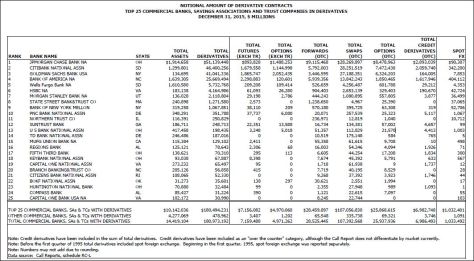
Currently the top 25 banks in the U.S. are on the hook for $181 trillion dollars!! (And that’s down 5.8% in the last quarter by the way. Their peak was $249.7 trillion in the second quarter of 2011.)
You may now ask what the bad news is? It’s a matter of a little law change made a couple of years ago unbeknownst to us mere mortals. The banks made a change in the law with the help of the feds which basically states, all bank owned derivatives will have priority over depositors’ money. This means that if the banks get in trouble and can’t pay back everyone, the derivative loans would have to be paid FIRST! This means that your deposits would be used to pay off the bank’s debt. This is referred to as a ‘bail in’. Considering the total deposits in the banks are around one trillion dollars, that could mean that a great deal of your life savings could go up in smoke — rapidly!!
You might say they can’t do that. Well, yes they can. If you read the fine print when you open an account with a bank, you are signing that you understand this (the above) process is in place and that you agree to it.
As you have heard more than once in your life, “Misery loves company.” I mention this because we are not alone! If you were to add up the derivatives around the world they would total $1.2 quadrillion!! You’ve heard a lot of rumors about how the global economy is shaky. These numbers put that concern into perspective.
At this point you might ask what you could do to protect yourself. The general answer is to buy tangible assets — i.e., real estate. But wait! If the real estate bubble part-II were to hit, real estate would drop in value quickly. Hence a large amount of that investment would be lost quickly (faster than you can sell).
The reason for my posting this information is to inform my readers of what’s happening (coming). It’s up to each of us to determine if this is truly a potential disaster waiting on the horizon and what each of us should do to prepare. Doing nothing is a plan. I’d suggest any other plan…
The following chart displays the top 25 banks and their derivative balances.
Sources:
- Market Watch website
- Market Watch charts showing comparative values/size of resources
- Last Quarterly report
.


Great article and references.
Thanks.
Have you seen the movie, The Big Short “?
LikeLike
NO!! And we want to see it. I guess we missed it in the theater — never even heard of it..? But now it’s on top of our list to watch when it hits the tube.
LikeLiked by 1 person
The movie and your information and advice confirm you are right in your assumptions.
I’m thinking about taking my money out of the bank I currently have that is also on the list for high derivatives and putting it in a credit union.
God bless
LikeLike